

Lime kiln structure diagram
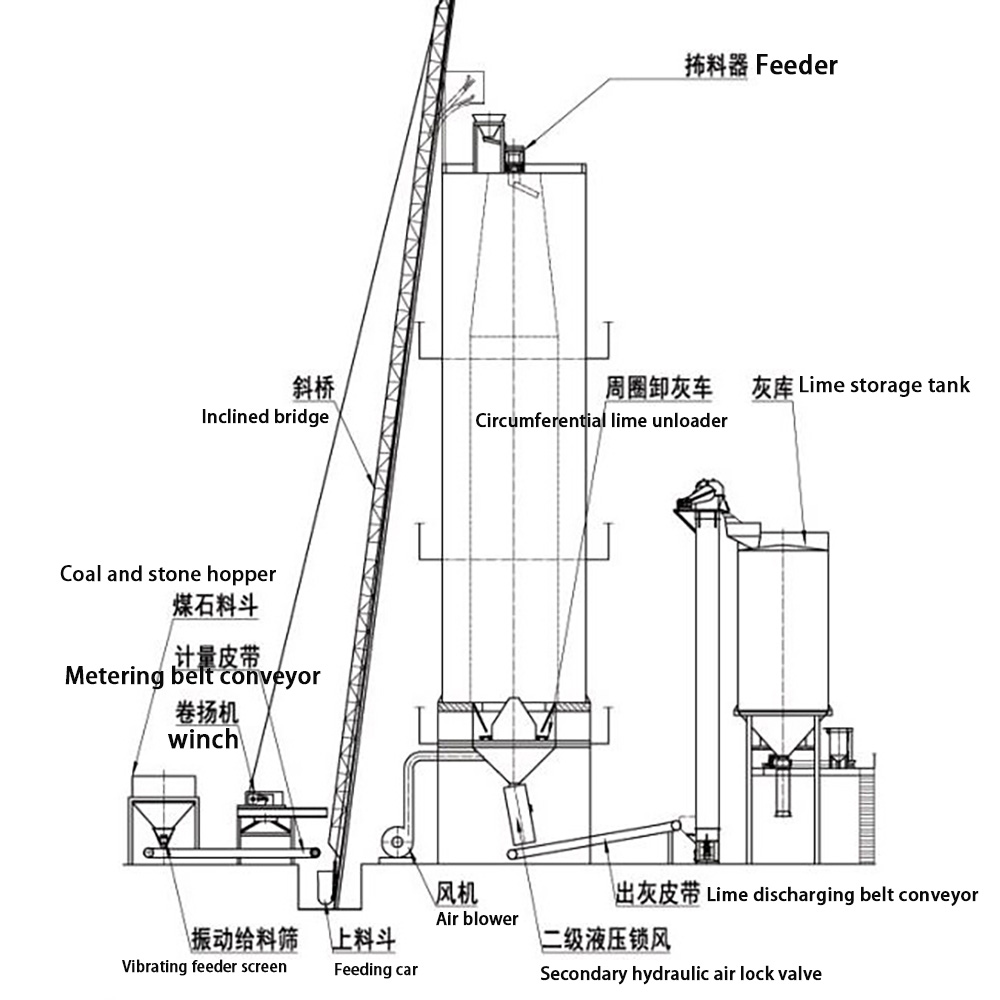
As the mainstream kiln type for lime production, lime shaft kiln is widely used in metallurgy, chemical industry, building materials and other industries due to its advantages of simple structure, low investment and high thermal efficiency. Modern lime kiln has developed into a highly mechanized and automated continuous production equipment, with its core components mainly including kiln body, feeding equipment, material distribution equipment, air supply equipment, ash unloading equipment, and automation control system. The following text will analyze the structure and function of each component one by one, and connect the complete production process flow.
1、 Kiln body structure
The kiln body is the main body of a lime vertical kiln, usually a vertical cylindrical structure with a steel shell lined with refractory material. From the inside out, the inner layer uses high alumina bricks as the working layer, which directly contacts high-temperature materials and airflow; The middle layer is made of insulation materials such as clay refractory bricks or aluminum silicate fiber felt insulation boards; The outer layer is a steel plate shell, and some kiln types also pour lightweight heat-resistant concrete between the steel shell and the insulation layer to further improve the insulation effect.
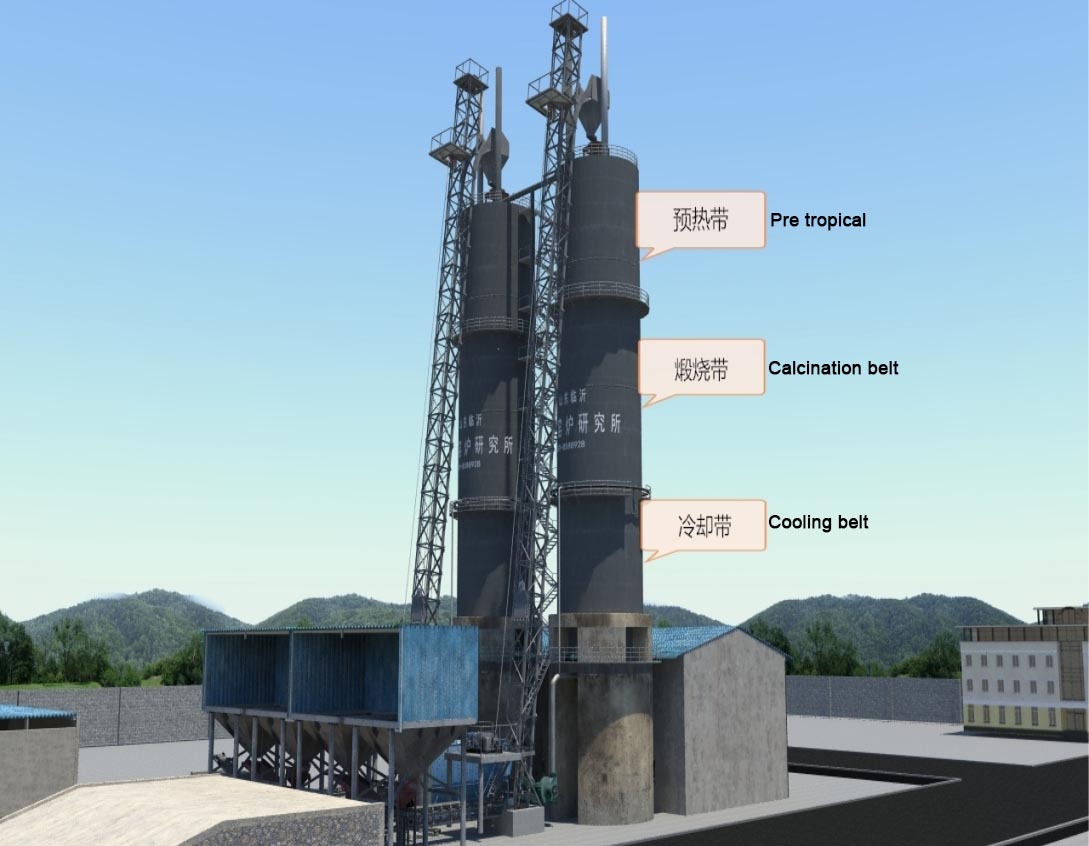
In terms of functional zoning, the kiln body is divided into three zones along the height direction:
Pre tropical zone (upper part): The material is preheated by rising hot flue gas here, and limestone begins to decompose preliminarily.
Calcination zone (middle): The temperature is the highest (usually controlled at 1000-1200 ℃), where limestone decomposes violently to produce quicklime (CaO).
Cooling zone (lower part): The calcined high-temperature lime exchanges heat with the blown cold air here, cooling itself while preheating the combustion air.
2、 Loading equipment
The feeding equipment is responsible for transporting the proportionally prepared limestone and fuel (coke, anthracite, etc.) from the ground to the top of the kiln. The common form is the hoist lifting system or bucket elevator: after the raw materials are loaded into the hopper, they are pulled by the hoist along the feeding inclined bridge to the top of the kiln and poured into the receiving hopper on the top of the kiln. This process has achieved mechanized operation, replacing traditional manual handling and significantly reducing labor intensity.
3、 Fabric equipment
Fabric is a key link that affects the distribution of airflow and the uniformity of calcination inside the kiln. After the material enters the receiving hopper at the top of the kiln, it needs to be evenly spread on the material surface inside the kiln through a material distribution device.
Modern shaft kilns often use rotary feeders (also known as volute feeders). Its working principle is that the material feeder rotates under power drive, evenly spreading the material in a dot or mesh pattern in various areas of the kiln section. Advanced fabric feeders can even achieve zoning or screening of fabrics, distributing small-sized ores around the kiln wall and large blocks of materials in the center to balance the airflow resistance inside the kiln and avoid "over burning" or "over burning" phenomena.
4、 Air supply equipment
The air supply system provides necessary combustion air for calcination and participates in the cooling of lime. The core equipment is a high-pressure centrifugal blower, which forces air from the bottom of the kiln into the kiln through ducts and caps.
The key technology lies in the uniformity of air distribution. After the wind enters from the bottom, it is evenly distributed throughout the entire section of the kiln through the annular air chamber and energy-saving pressure equalizing air cap. The hood design features numerous air vents to ensure even airflow through the material layer. This "downward pumping and upward feeding" counterflow heat exchange mechanism effectively transfers the heat of high-temperature lime to the cold air, which not only cools the product but also preheats the combustion air, significantly reducing heat consumption.
5、 Lime unloading equipment
The lime unloading device is located at the bottom of the kiln and is responsible for continuously or intermittently discharging the calcined lime outside the kiln. Typical configurations include automatic ash discharge gate valves, air lock ash discharge machines, and ash discharge belt conveyors.
When unloading ash, the automatic ash discharge gate valve is opened, and the lime falls into the air locking ash discharge machine (such as the screw cone ash discharge machine or the rotary ash discharge valve). This equipment plays a sealing and air locking role while discharging, preventing excessive external cold air from being sucked in or positive pressure gas from leaking out of the kiln, and stabilizing the thermal system inside the kiln. Finally, the lime is transported to the finished product warehouse by the ash discharge belt conveyor.
6、 Automated control equipment
The automation system is the "brain" of modern lime kilns. Using PLC (Programmable Logic Controller) as the core, monitor and adjust the entire process.
Its functions include:
Automatic batching and weighing: precise control of the mixing ratio of limestone and fuel.
Level and temperature monitoring: Sensors and thermocouples are installed in different parts of the kiln to monitor the level and temperature of the calcination zone in real time.
Chain control: realize the timing linkage and automatic adjustment of feeding, fabric distribution, air supply, ash unloading and other links to ensure stable kiln conditions. Each shift only requires 1-2 operators to be competent.
7、 Production process flow
Based on the operation of various systems, the complete process flow of lime shaft kiln can be summarized as follows:
Raw material preparation and feeding: Limestone (usually requiring particle size of 30-80mm or 80-120mm, CaO content>97%) is mixed with fuel (anthracite or coke) in a ratio of about 1.6-1.75:1, accurately weighed and mixed by an electromagnetic vibration feeder and a measuring hopper, and then sent to the top of the kiln by a hoist.
Fabric and calcination: The mixed material is evenly distributed into the kiln through a rotating fabric spreader. The material slowly descends by gravity, passing through the preheating zone, calcination zone (1100 ± 50 ℃), and cooling zone in sequence. In the calcination zone, calcium carbonate decomposes into calcium oxide (CaO) and carbon dioxide (CO ₂).
Supply of air and heat exchange: The blower forcibly blows air from the bottom of the kiln, and the upward and downward materials of the air exchange heat in reverse flow, providing oxygen required for fuel combustion while taking away heat to cool the finished product.
Ash unloading and finished products: The cooled lime is discharged through the bottom ash unloading device (automatic gate valve+lock air ash outlet) and transported to the finished product warehouse by a belt conveyor. The generated flue gas is purified through two stages of bag filter and water film filter before being discharged, meeting environmental protection requirements.
The lime shaft kiln efficiently and cleanly converts limestone into high-quality lime through the precise coordination of these six systems and the principle of counter current heat exchange.


